A primer on European domains (ccTLDs)
Sept. 6, 2026
In this guide
In our Guide "Leaving Gmail? Get your own domain first" we made the case for getting your own domain before picking an email provider. That personal domain is the part of your identity that stays, even if you switch your email providers.
This primer covers the follow-up question: which ccTLD (country code top-level domain; such as .de, .fr, .es, .eu) should one choose? The European Union has 27 member-state endings plus .eu. These TLDs differ in who may register them, which registry rules apply, and what they cost at the registry level. Join us for a deep dive.

What makes a domain European?
The TLD and registry of record
Every ccTLD has a registry of record, usually run by a governmental body, public research institution or non-profit organization. That registry maintains the registration system and the authoritative data from which the distributed DNS is served. For example, the .de domain space is managed by DENIC, a German not-for-profit cooperative. The registry of record defines the rules and policies that actually govern a TLD. Such as:
- who is eligible to register a domain
- what information must be provided during registration
- what special characters are allowed as part of the domain name
- resolving ownership and trademark disputes
The popular .com and .net TLDs are operated by Verisign, a private US company. Thus, registering a .com through a French registrar does not move the registry entry out of Verisign's US-based jurisdiction, although the registrar contract and other parts of the service may still be governed by European law.
The registrar
Most registries do not directly sell ccTLDs to the public. Instead, they delegate this to accredited registrars, which are private businesses that handle billing, customer support and other day-to-day operations. Such registrars include large US firms such as GoDaddy or local European domain registrars.
In practice today, you can buy a non-EU TLD such as .com from a European registrar as well as vice versa, an EU ccTLD such as .de from a US registrar.
A note on root servers
Root servers are the internet's lookup starting point: they assign which servers handle each TLD like .de or .fr. Every uncached DNS lookup begins by asking the root servers "Who handles .de zone?", then your resolver asks the DENIC servers "Who handles example.de?", and finally asks example.de's configured nameservers "what's the IP address of www.example.de?".
So the root servers know nothing about individual domains, just what the authoritative nameservers are for the 1500+ TLDs that exist today.
Twelve independent operators run these root servers, but the list they serve (root zone files) comes from IANA, ICANN's technical arm - and therefore ultimately from a US-based entity, subject to US jurisdiction.
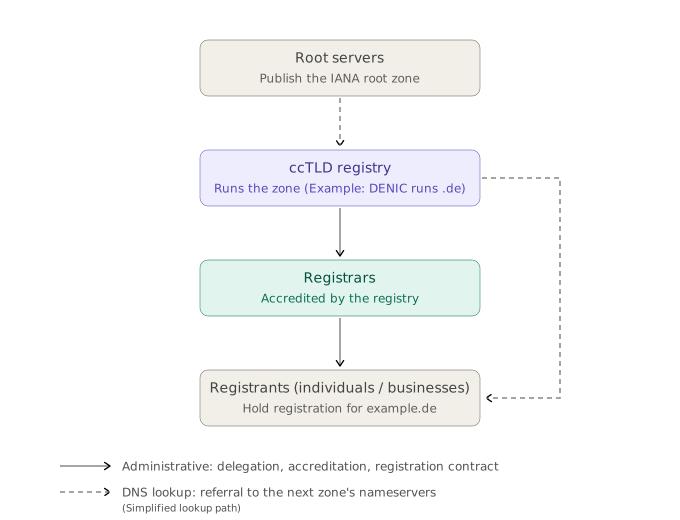
So in practice, the European ccTLDs are generally operated by sovereign European organizations, but technically still depend on the root server delegation which is subject to US jurisdiction.
Who can register what
Today most EU ccTLDs are open for registration for anyone in the world. That was not always true, many started out as citizen-only or resident-only, but liberalized their registration policies over the years.
All EU country domains at a glance
Open worldwide
- .at
- .be
- .cy
- .cz
- .fi
- .gr
- .lt
- .lu
- .lv
- .pl
- .ro
- .se
- .si
Open worldwide, with extra requirements
- .de
- German service address on request
- .dk
- Verification depends on residence and risk
- .ee
- ID verification
- .hu
- Justification may be required
- .nl
- No proxy registrations
- .pt
- Tax ID and IBAN required
EU/EEA-only
- .eu
- Eligible EU/EEA citizens, residents or established organisations
- .fr
- Residents or entities in the EU/EEA plus Switzerland
- .it
- EEA, Switzerland, UK, Vatican City, San Marino
- .sk
- Address in the EU/EEA/EFTA or the UK
- .bg
- Bulgarian or EU citizens and entities; Bulgarian permanent residents; other cases conditional
- .hr
- EU entities; EU citizens with a Croatian OIB
Restricted/Other
- .es
- Applicants with interests or ties to Spain
- .ie
- Proven connection to Ireland
- .mt
- Qualifying legal entities; application reviewed
The Brexit lesson
Eligibility can be enforced for as long as you hold the domain, not only on the day you register it. On 1 January 2021, EURid suspended around 81,000 .eu domains linked to UK-based registrants who no longer met the rules. About 48,000 remained ineligible and were ultimately withdrawn.
Jurisdiction: who can take your domain away
In 2012, US authorities seized bodog.com, a gambling website allegedly offering illegal gambling to US-based customers. Although the domain was registered through a Canadian registrar, the US was able to seize the domain by ordering Verisign (who operates the .com registry) to lock bodog.com and hand over control to the US government.
This case proves that action at the .com registry level is enough, rather than relying on the (foreign) registrar to take the site down or cooperate with the US government.
To be fair, domain seizures are still extremely rare. The more realistic ways of losing control over your domain are forgetting to pay your renewal fees, trademark infringements or losing eligibility to hold a domain (as seen in the Brexit case).
How to choose
For most people the obvious choice is the ccTLD of their home country, or .eu if you want the explicitly European identity. From there, ask yourself:
1. Will you still qualify in twenty years? If you might ever move out of the EU, an open TLD like .de or .nl is a safer long-term domain than a residency-restricted one.
2. Register through a European registrar. The registry determines the TLD's rules and registry-level exposure, while your contract, support and billing sit with the registrar. Our domain registrar category compares various European providers.
It can put your registrar contract under European law, but it does not move the .com registry record out of Verisign's US-based jurisdiction or remove US registry-level exposure. The bodog.com seizure showed that US authorities could obtain action at the .com registry level even though the domain used a Canadian registrar. Both the registry and registrar layers matter.
Usually yes. .de, .nl, .be, .at, .cz, .se, .fi, .pl and most others are open worldwide, though registries such as .dk and .ee verify holder data, and DENIC may ask a registrant outside Germany to name a German address for legal service if a dispute comes up. .eu, .fr, .it, .bg, .hr, .sk and .ie have explicit eligibility conditions; .es, .hu and .mt also have qualifications or review rules.
If you are an EU citizen, no. Since 2019, citizenship counts regardless of where you reside. If your eligibility rests on residence alone, consider your future residence plans.
Among published standard renewal prices, .it, .es, .nl, .eu, .fr and .be sit near the low end at roughly 3.30€ to 5.50€ before the registrar's costs and margin. Retail prices may differ.